Nevada Dog Registration Information
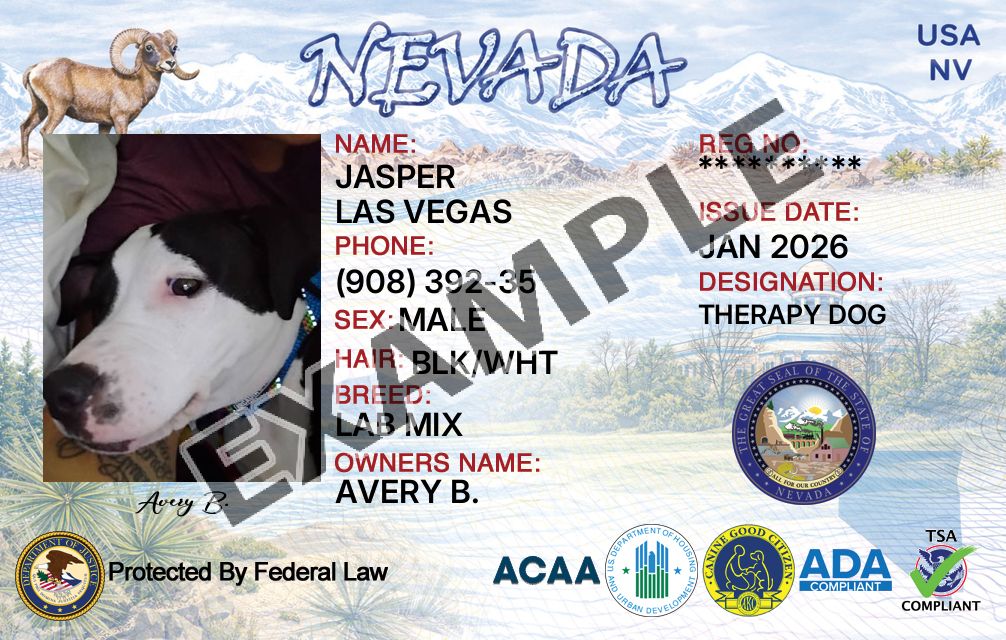
State Licensed, Service Dogs and Emotional Support Dogs in Nevada
Where Do I Register My Dog in Nevada for a Service Dog or Emotional Support Dog?
If you’re searching for where do I register my dog in Nevada for my service dog or emotional support dog, the most important thing to know is this: in Nevada, there typically isn’t one statewide “service dog registry” or “emotional support dog registry” that grants legal status. Instead, most people are really asking about a dog license in Nevada (and rabies compliance), which is usually handled by local city or county animal services—the same offices that answer animal control dog license Nevada questions and enforce local rabies and animal ordinances.
This page explains where to register a dog in Nevada (meaning licensing or local registration), how rabies vaccination requirements fit in, and how dog licensing differs from service dog legal status and emotional support animal rules.
Where to Register or License Your Dog in Nevada
Nevada dog licensing and enforcement are commonly handled at the county or city level. Below are several examples of official offices in Nevada that residents frequently contact about licensing/registration, animal control, and rabies compliance. If you’re unsure which jurisdiction you’re in (city limits vs. unincorporated county), start with your city’s animal services (if you live in an incorporated city), or the county animal authority.
Southern Nevada (Clark County area)
Clark County Animal Protection Services (APS)
- Address: 4701 W. Russell Rd.
- City/State/ZIP: Las Vegas, NV 89118
- Phone: (702) 455-7710
- Email: AnimalProtectionServicesInfo@clarkcountynv.gov
-
Hours:
Dispatch: Mon–Sun 6:30am–4:45pm
Office: Mon–Thu 7:30am–5:30pm (Closed Fri–Sun)
City of Henderson Animal Protection Services
- Address: 300 E. Galleria Dr.
- City/State/ZIP: Henderson, NV 89011
- Phone: (702) 267-4970
-
Hours:
Monday–Saturday 10:00am–5:00pm (Closed Sunday & holidays)
Northern Nevada (Reno/Sparks/Washoe County area)
Washoe County Regional Animal Services
- Address: 2825 Longley Lane, Suite A
- City/State/ZIP: Reno, NV 89502
- Phone: (775) 353-8900
- Email: pets@washoecounty.gov
-
Hours:
Office: Mon–Fri 8:00am–5:00pm; Sat 9:00am–3:00pm; Sun (redemptions by appointment) 9:00am–3:00pm
Western Nevada (Carson City area)
Carson City Animal Services (provided through Nevada Humane Society, Carson City)
- Address: 549 Airport Road
- City/State/ZIP: Carson City, NV 89701
- Phone: (775) 887-2171
-
Hours (Licensing & Redemption – Carson City only):
Monday 11:00am–4:00pm; Tuesday–Saturday 8:00am–6:30pm; Closed Sunday
Overview of Dog Licensing in Nevada
There’s no single statewide “Nevada dog license office”
When people ask where to register a dog in Nevada, they often expect a statewide agency. In practice, Nevada is a “local control” state for many pet rules: the county, city, or town you live in commonly sets licensing requirements, renewal schedules, fees, and enforcement procedures. Some jurisdictions require annual licensing, some issue multi-year licenses, and some may focus more heavily on identification and rabies tag requirements.
The statewide baseline: rabies control programs and local authority
Nevada regulations require that each county, city, and town appoint a rabies control authority and enact an ordinance for a rabies control program. Those local ordinances must include provisions requiring dogs (and other listed animals) to be vaccinated against rabies as prescribed in state regulation, and they also authorize local authorities to issue citations when animals are not properly vaccinated. The same regulation framework also recognizes that local governments may require licenses for dogs, cats, and ferrets.
How Dog Licensing Works Locally in Nevada
Step 1: Identify your jurisdiction (city vs. unincorporated county)
The right place to get an animal control dog license Nevada depends on where you live:
- Incorporated city residents (for example, Henderson) often license through the city’s animal services.
- County residents in unincorporated areas typically follow county animal authority rules.
- Independent cities (like Carson City) may provide licensing through the city’s designated animal services provider.
If you’re uncertain, call the nearest official animal services office and ask: “Am I in your jurisdiction for dog licensing?” Have your address ready.
Step 2: Confirm rabies vaccination and get the right documentation
Rabies vaccination is a core requirement behind most licensing systems. Local ordinances generally require current rabies vaccination, and Nevada regulations specify that only an acceptable rabies vaccination certificate is valid proof when required by the rabies control authority. In other words: your vet paperwork matters.
Step 3: Apply, pay fees, and keep tags/records current
A typical dog license in Nevada (local license) process looks like this:
- Submit an application (online, by mail, or in person—varies by office).
- Provide rabies vaccination proof and any other required documentation (spay/neuter status may affect fees in some areas).
- Pay the licensing fee.
- Receive a license tag (and sometimes additional documentation). Keep a copy of the record for your files.
Even if your dog is a service dog or emotional support animal, local licensing can still apply because licensing is generally about public health, identification, and rabies control—not about disability status.
Rabies vaccination requirements and enforcement
Nevada’s rabies control framework requires local governments to maintain rabies control programs and authorizes citations for animals not vaccinated according to the applicable rules. Local rabies control authorities also manage bite reports and quarantine/observation procedures, and Nevada rules include special handling provisions in some circumstances for service animals or service animals in training (for example, specific quarantine waivers may be available when conditions are met).
Service Dog Laws in Nevada
Service dog legal status is not created by a registry
Under the Americans with Disabilities Act (ADA), a service animal is a dog that is individually trained to do work or perform tasks for a person with a disability. The dog’s tasks must be directly related to the disability. The ADA also makes clear that service animals are not required to be certified, registered, or professionally trained—and businesses generally cannot demand documentation that the dog is “registered” as a service dog.
What businesses can ask (and what they can’t)
If it isn’t obvious what your dog does, ADA guidance says staff may ask only two questions:
- Is the dog a service animal required because of a disability?
- What work or task has the dog been trained to perform?
They cannot ask for medical details, require a “service dog registration,” or insist on a vest or ID as proof.
Service dog vs. dog license in Nevada
A service dog may have legal access rights in many public settings, but a dog license in Nevada is a separate local compliance matter that may still apply. Think of licensing as “local animal law + public health,” and service dog status as “disability access rights based on trained tasks.”
Emotional Support Animal Rules in Nevada
ESAs are not service animals under the ADA
Emotional support animals (ESAs) can be very important to a person’s well-being, but under ADA guidance, emotional support or comfort alone is not a trained task and does not make a dog a service animal for public-access purposes.
ESAs are mainly a housing accommodation concept
Federal housing guidance explains “assistance animals” as animals that do work, provide assistance, perform tasks, or provide emotional support that alleviates one or more identified effects of a person’s disability. In housing, an ESA may be considered an assistance animal (not a pet) and may be requested as a reasonable accommodation to pet restrictions, depending on the situation and documentation rules that apply.
ESA paperwork does not replace local licensing
Even if your landlord recognizes your dog as an ESA for housing purposes, that does not automatically satisfy local “where to register a dog in Nevada” requirements. You may still need to comply with local rabies and licensing ordinances through your city or county.
Frequently Asked Questions
There is generally no ADA-required service dog registry. Service dog status is based on whether the dog is trained to perform disability-related tasks. However, you may still need a dog license in Nevada from your local jurisdiction, plus compliance with rabies vaccination rules.
“Las Vegas” can mean different jurisdictions (incorporated cities or unincorporated Clark County). Start by confirming whether you are in an incorporated city (with its own animal services rules) or unincorporated county. For animal control and many related services, Clark County Animal Protection Services is a key official contact for the area. If you’re within a specific city like Henderson, contact that city’s animal protection services for licensing steps.
No. A rabies tag typically shows vaccination status, while a local license tag (if required) shows local registration/licensing. Many jurisdictions require both: current rabies vaccination documentation and a local license.
Not under the ADA. Service dogs are trained to perform specific tasks related to a disability. ESAs generally do not have the same public-access rights, though they may be considered assistance animals for housing accommodations under fair housing rules.
This page lists examples, not every jurisdiction. To locate the correct office quickly:
- Call your city hall (or county information line if applicable) and ask which department handles dog licensing and rabies enforcement.
- Ask whether you are in city limits or unincorporated county.
- Confirm what documents they require (rabies certificate, ID, proof of residency, etc.).
Key Takeaway
If you’re asking where do I register my dog in Nevada for my service dog or emotional support dog, start with local animal services: dog licensing is usually local, rabies compliance is a statewide public health priority enforced locally, and neither a “service dog registry” nor an “ESA registry” is what creates legal status. When in doubt, contact your city or county animal services office and ask specifically about dog license in Nevada requirements for your address.
What You May Need
- rabies vaccination proof
- identification
- proof of residency
- licensing fee
Reminder
Licensing requirements and office locations may change. Residents should verify details with their local animal services office within Nevada.
Register A Dog In Other Nevada Counties
Select your county from the dropdown below to get started with your dog’s ID card. Requirements and license designs may vary by county, so choose your location to see the correct options and complete your pup’s registration.
- Carson City County Dog Registration
- Churchill County Dog Registration
- Clark County Dog Registration
- Douglas County Dog Registration
- Elko County Dog Registration
- Esmeralda County Dog Registration
- Eureka County Dog Registration
- Humboldt County Dog Registration
- Lander County Dog Registration
- Lincoln County Dog Registration
- Lyon County Dog Registration
- Mineral County Dog Registration
- Nye County Dog Registration
- Pershing County Dog Registration
- Storey County Dog Registration
- Washoe County Dog Registration
- White Pine County Dog Registration